
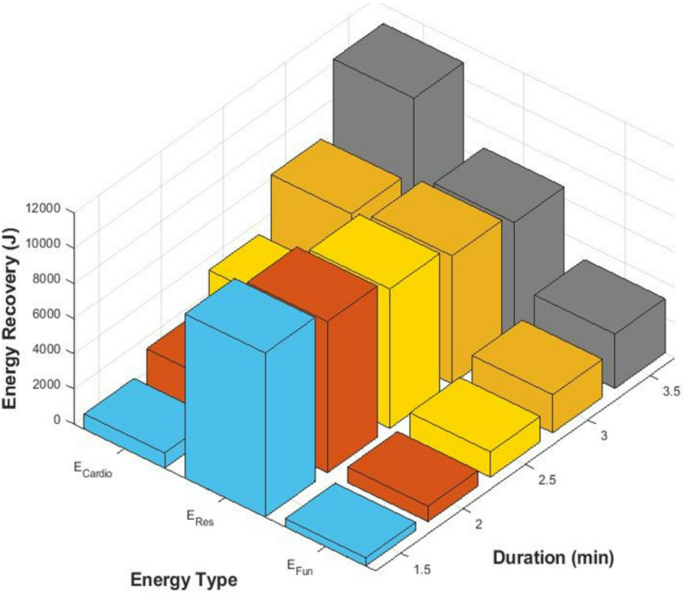
This section presents the SynergyFit Energy Recovery Model, a unified theoretical framework designed to quantify recoverable electrical energy across resistance, cardiovascular, and functional training modalities. Rooted in principles of classical mechanics and biomechanics, the model derives energy output using modality-specific force–displacement and power–time relationships, thereby capturing the unique dynamics of each exercise form.
The framework integrates key physiological and mechanical parameters, including mass, velocity, displacement, and rest intervals, while introducing synergistic efficiency terms to account for real-world conversion losses and system non-idealities. These components are systematically coupled into a scalable formulation that estimates total energy recovery potential within multi-modal training environments.
To establish robustness, the section proceeds by deriving sub-models for individual modalities, formulating hypotheses that govern their combined performance, and benchmarking the integrated framework through mathematical simulations under standardized gym conditions. Sensitivity analyses are then conducted to identify the most influential performance variables, providing insight into how design and training parameters can be optimized to maximize energy harvesting efficiency.
Energy recovery model for resistance training
To determine the energy recovery potential of resistance training and equipment, the work done, \(\:W\), during the training session is calculated by integrating the force function \(\:F\left(x\right)\) over distance (displacement) \(\:x\), from the following governing equation27:
where, \(\:W\:\) is the work done, \(\:\:F\:\)is the force applied, and \(\:d\) is the distance covered by the applied force.
Given a set of discrete data points or a complicated function of force \(\:F\left(x\right),\:\)the Analytical Integration method is used28.
For \(\:n\) nodes and weights \(\:\left({x}_{i},\:{w}_{i}\right)\):
$$\:\:W\approx\:{\sum\:}_{i=1}^{n}{w}_{i}\:F\left({x}_{i}\right)$$
(2)
Since integrating force over displacement gives work done, Eq. (2) can be rewritten as;
$$\:W={\int\:}_{{x}_{1}}^{{x}_{2}}F\left(x\right)dx$$
(3)
Assumptions:
-
1.
\(\:F\left(x\right)\)is a first-order polynomial function such that \(\:F\left(x\right)={a}_{0}+{a}_{1}x\);
-
2.
Consider the number of reps of training as well as resting time, training momentum, and force exerted.
$$\:W={\int\:}_{{x}_{1}}^{{x}_{2}}\left({a}_{0}+{a}_{1}x\right)dx\:$$
$$\:W={\left[{a}_{0}x+{a}_{1}\frac{{x}^{2}}{2}\right]}_{{x}_{1}}^{{x}_{2}}$$
(4)
Employing the Analytical Integration method, Eq. (4) is simplified as:
$$\:W=\left({a}_{0}\left({x}_{2}-{x}_{1}\right)+{a}_{1}\frac{{(x}_{2}^{2}-{x}_{1}^{2})}{2}\right)$$
(5)
where, \(\:{a}_{0}\:\) is the momentum function of displacement for resistance training, \(\:{a}_{1}\:\) is the force function of displacement for resistance training, \(\:{x}_{1}\:\) is the initial displacement, and \(\:{x}_{2}\:\) is the initial displacement.
The momentum function of resistance training represents the intensity of exercise. Exercise intensity is given as:
$$\:{a}_{0}=\:{m}_{0}v.\frac{N}{{R}_{T}}$$
(6)
where, \(\:{a}_{0}\:\) is the momentum function of displacement for resistance training, \(\:{m}_{0}\:\) is the mass of plates to be lifted, \(\:v\:\) is the velocity of weight lifting, \(\:N\:\) is the number of reps for each training round, and \(\:{R}_{T}\:\) is the initial displacement.
The force function of displacement for resistance training represents the resistance level considering technical parameters such as mass of plates, velocity, duration of exercise, and differential displacement constant (\(\:\sigma\:\)) which accounts for the portion of the total displacement occupied by the plate stack.
$$\:{a}_{1}=\:{m}_{0}.\frac{dV}{dT}.\frac{1}{\sigma\:}$$
(7)
where, \(\:{a}_{1}\:\) is the force function of displacement for resistance training, \(\:{m}_{0}\:\) is the mass of plates to be lifted, \(\:dV\:\) is the velocity of weight lifting, \(\:dT\:\) is the training duration, and \(\:\sigma\:\:\) is the initial displacement.
Combining Eqs. (5), (6), and (7), the resistance training model becomes:
$$\:W=\:\left({m}_{0}v.\frac{N}{{R}_{T}}\text{}\left({x}_{2}-{x}_{1}\right)+\:{m}_{0}.\frac{dV}{dT}.\frac{{(x}_{2}^{2}-{x}_{1}^{2})}{2\sigma\:}\right)$$
(8)
According to the law of conservation of energy, mechanical work can be converted into electrical energy29,30 as shown in Eq. (9):
$$\:{E}_{\text{E}\text{l}\text{e}\text{c}}=\eta\:\times\:W$$
(9)
where, \(\:{E}_{\text{E}\text{l}\text{e}\text{c}}\) is the electrical energy, \(\:\eta\:\) is the efficiency of the generator, and \(\:W\) is the mechanical work done.
From Eq. (9), and considering the synergistic efficiency (\(\:{\eta\:}_{sys.}^{R}\)), of resistance training, Eq. (8) becomes:
$$\:{E}_{R}=\:{\eta\:}_{sys.}^{R}\left({m}_{0}v.\frac{N}{{R}_{T}}\text{}\left({x}_{2}-{x}_{1}\right)+\:{m}_{0}.\frac{dV}{dT}.\frac{{(x}_{2}^{2}-{x}_{1}^{2})}{2\sigma\:}\right)$$
(10)
where, \(\:{E}_{R}\) is the Energy produced from resistance training, \(\:{\eta\:}_{sys.}^{R}\) is the synergistic efficiency of resistance training, \(\:{m}_{0}\:\) is the mass of plates to be lifted, \(\:v\:\) is the velocity of weight lifting, \(\:N\:\) is the number of reps for each training round, \(\:{R}_{T}\:\) is the resting time, \(\:dV\:\) is the velocity of weight lifting, \(\:dT\:\) is the training duration, and \(\:\sigma\:\:\) is the initial displacement.
The resistance training model is based on the work done during the lifting process, represented by the force-displacement relationship. The derived model considers factors such as the number of repetitions, resting time, and training momentum. The resulting expression (Eq. 10) quantifies the electrical energy recoverable from resistance training, incorporating the synergistic efficiency of the system.
Energy recovery model for cardio training
To determine the energy recovery potential of cardio training and the use of cardio training machines, power output \(\:P\left(t\right)\) is integrated over time \(\:t\), from the following governing equations31:
where, \(\:P\) is the power output, \(\:W\) is the work done, and \(\:t\) is the time taken.
This equation can be rewritten in terms of force \(\:\left(F\right)\), distance \(\:\left(d\right)\) and time \(\:\left(t\right)\) since the product of force and distance (displacement) is work done.
The expression \(\:\frac{d}{t}\) also represents displacement as a ratio to time which is velocity. Hence the governing Equation can be further expressed as the product of the force function of time and velocity function of time becomes Eq. (12)32,33:
$$\:P\left(t\right)=F\left(t\right)\times\:v\left(t\right)$$
(12)
where, \(\:P\left(t\right)\) is the instantaneous power at time \(\:t,\) \(\:F\left(t\right)\) is a force function at time \(\:t\), and \(\:v\left(t\right)\) is a velocity function of time\(\:\:t.\).
If \(\:F\left(t\right)\) and \(\:v\left(t\right)\) are simple functions such that \(\:F\left(t\right)=at\:\)and \(\:v\left(t\right)=bt,\) then the Analytical Integration method is employed for the following function.
$$\:P\left(t\right)=at\times\:bt=ab{t}^{2}$$
(13)
$$\:E={\int\:}_{0}^{T}P\left(t\right)dt$$
$$\:E={\int\:}_{0}^{T}ab{t}^{2}dt$$
$$\:E{=\left[\frac{ab}{3}{t}^{3}\right]}_{0}^{T}$$
$$\:\:\:E=\:\frac{ab}{3}{T}^{3}$$
(14)
To avoid overestimating energy output, resting intervals between cardio routines are incorporated into the model. Given that energy scales cubically with time, the square of the resting interval is applied as a correction factor to normalize the effective training duration34.
Equation (14) becomes;
$$\:E=\frac{ab}{3{{R}_{T}}^{2}}{T}^{3}$$
(15)
Applying the concept of energy conversion from Eq. (9) with the synergistic efficiency (\(\:{\eta\:}_{sys.}^{C}\)) for cardio training, Eq. (15) becomes:
$$\:{E}_{C}={\eta\:}_{sys.}^{c}\frac{ab}{3{{R}_{T}}^{2}}{T}^{3}$$
(16)
where, \(\:{E}_{C}\) is the energy produced from cardio training, \(\:{\eta\:}_{sys.}^{C}\) is the synergistic efficiency of cardio training, \(\:a\:\) is the force function of cardio training, \(\:b\:\) is the velocity function of cardio training, \(\:{R}_{T}\:\) is the resting time, and \(\:T\:\) is the training duration.
The cardio training model derives energy recovery based on power output, which is a function of force and velocity over time. The final expression (Eq. 16) integrates the training duration and resting intervals to estimate the energy produced during cardio sessions, adjusted by the system’s synergistic efficiency.
Energy recovery model for functional training
Functional training modes are characterized by the interplay of both potential and kinetic energy due to dynamic movements and load-bearing postures during training sessions and equipment usage35. These exercises typically involve repeated lifting, swinging, or bodyweight-driven actions, each contributing to changes in speed and elevation, thereby activating kinetic and potential energy systems. To estimate the energy recovery potential in functional training environments, the total mechanical energy, comprising both potential and kinetic components, is calculated and integrated over the duration of the exercise session36.
The governing equations for these energy forms are as follows:
Kinetic energy equation27:
$$\:{E}_{\text{k}\text{i}\text{n}\text{e}\text{t}\text{i}\text{c}}\left(t\right)=\frac{1}{2}{mv\left(t\right)}^{2}$$
(17)
where, \(\:{E}_{\text{k}\text{i}\text{n}\text{e}\text{t}\text{i}\text{c}}\left(t\right)\) is the kinetic energy, \(\:m\) is the mass, and \(\:v\) is the velocity.
Potential Energy Eq. (31):
$$\:{E}_{\text{p}\text{o}\text{t}\text{e}\text{n}\text{t}\text{i}\text{a}\text{l}}\left(t\right)=mgh\left(t\right)$$
(18)
where, \(\:{E}_{\text{p}\text{o}\text{t}\text{e}\text{n}\text{t}\text{i}\text{a}\text{l}}\left(t\right)\) is the potential energy, \(\:m\) is the mass, \(\:g\) is the gravity, and \(\:h\) is the height.
If \(\:v\left(t\right)\) and \(\:h\left(t\right)\) are assumed to be linear time-dependent functions such that \(\:v\left(t\right)=at\:\)and \(\:h\left(t\right)=bt,\:\) the Analytical Integration method is employed to determine the total recoverable energy over the training duration.
Equation (17) becomes:
$$\:{E}_{\text{k}\text{i}\text{n}\text{e}\text{t}\text{i}\text{c}}\left(t\right)=\frac{1}{2}{m{a}^{2}t}^{2}$$
(19)
Equation (18) also becomes:
$$\:{E}_{\text{p}\text{o}\text{t}\text{e}\text{n}\text{t}\text{i}\text{a}\text{l}}\left(t\right)=mgbt$$
(20)
Integrating the sum of potential and kinetic energy gives;
$$\:E={\int\:}_{0}^{T}\left({E}_{\text{k}\text{i}\text{n}\text{e}\text{t}\text{i}\text{c}}\left(t\right)+{E}_{\text{p}\text{o}\text{t}\text{e}\text{n}\text{t}\text{i}\text{a}\text{l}}\left(t\right)\right)dt$$
$$\:E={\int\:}_{0}^{T}\left(\frac{1}{2}{m{a}^{2}t}^{2}+mgbt\right)dt$$
$$\:E={\left[\frac{1}{2}m{a}^{2}\frac{{t}^{3}}{3}+mgb\frac{{t}^{2}}{2}\right]}_{0}^{T}$$
$$\:E=\frac{1}{6}m{a}^{2}{T}^{3}+\frac{1}{2}mgb{T}^{2}$$
(21)
For functional training, which involves combined kinetic and potential energy contributions, the model accounts for trainer rest periods to ensure realistic energy estimations. As energy depends on a cubic function of time, the cube of the resting time is introduced as a divisor to adjust for non-continuous activity durations34.
Equation (21) becomes:
$$\:E=\frac{1}{6{{R}_{T}}^{3}}m{a}^{2}{T}^{3}+\frac{1}{2{{R}_{T}}^{2}}mgb{T}^{2}$$
(22)
Applying the concept of energy conversion in Eq. (9) with the synergistic efficiency (\(\:{\eta\:}_{sys.}^{F}\)) for functional training leads to the following expression for the total energy produced during functional training sessions:
$$\:{E}_{F}=\:{\eta\:}_{sys.}^{F}\left(\frac{1}{6{{R}_{T}}^{3}}m{a}^{2}{T}^{3}+\frac{1}{2{{R}_{T}}^{2}}mgb{T}^{2}\right)$$
(23)
where, \(\:{E}_{F}\) is the energy produced from functional training, \(\:{\eta\:}_{sys.}^{F}\) is the synergistic efficiency of functional training, \(\:m\:\) is the mass of plates of functional machines, \(\:a\:\) is the velocity of weight lifting, \(\:g\:\) is the gravity, \(\:b\:\) is the height through which weight is lifted, \(\:{R}_{T}\:\) is the resting time, and \(\:T\:\) is the training duration.
The functional training model considers both kinetic and potential energy contributions during exercises involving complex movements. The derived equation (Eq. 23) accounts for the mass, velocity, and height of the exercise, providing an estimate of the recoverable energy, again adjusted by synergistic efficiency.
Unified multi-modal energy recovery model
Combining the contributions from the from resistance, cardio, and functional training modes, gives the total recoverable energy during a complete training session.
Total energy recovery model
$$\:{E}_{\text{R}\text{E}\text{C}}={E}_{R}+{E}_{C}+{E}_{F}$$
(24)
$$\:{E}_{\text{R}\text{E}\text{C}}={\eta\:}_{sys.}^{R}\left({m}_{0}v.\frac{N}{{R}_{T}}\text{}\left({x}_{2}-{x}_{1}\right)+\:{m}_{0}.\frac{dV}{dT}.\frac{{(x}_{2}^{2}-{x}_{1}^{2})}{2\sigma\:}\right)+{\eta\:}_{sys.}^{c}\frac{ab}{3{{R}_{T}}^{2}}{T}^{3}+{\eta\:}_{sys.}^{F}\left(\frac{1}{6{{R}_{T}}^{3}}m{a}^{2}{T}^{3}+\frac{1}{2{{R}_{T}}^{2}}mgb{T}^{2}\right)$$
(25)
By summing the contributions from resistance, cardio, and functional training models, the total energy recoverable during a complete training session is determined. The integrated model dubbed “SynergyFit Energy Recovery Model” (Eq. 25) offers a comprehensive approach to estimating overall energy recovery, crucial for optimizing energy harvesting in multi-modal training environments.
Hypotheses derived from the synergyfit framework
The developed models form the base framework for calculations and mathematical simulations. The following hypotheses are formulated from the various models developed in this chapter.
Hypothesis 1: energy production in resistance training
The energy \(\:{E}_{\text{r}\text{e}\text{s}\text{i}\text{s}\text{t}\text{a}\text{n}\text{c}\text{e}}\) produced during resistance training is directly proportional to the mechanical work done.
$$\:{H}_{1}:{E}_{\text{r}\text{e}\text{s}\text{i}\text{s}\text{t}\text{a}\text{n}\text{c}\text{e}}\propto\:{\int\:}_{{x}_{1}}^{{x}_{2}}F\left(x\right)dx$$
(26)
Hypothesis 2: energy production in cardio training
The energy \(\:{E}_{\text{c}\text{a}\text{r}\text{d}\text{i}\text{o}}\) produced during cardio training increases as mechanical power output and exercise duration increase.
$$\:{H}_{2}:{E}_{\text{c}\text{a}\text{r}\text{d}\text{i}\text{o}}\propto\:{\int\:}_{0}^{T}P\left(t\right)dt$$
(27)
Hypothesis 3: energy production in functional training
The energy \(\:{E}_{\text{f}\text{u}\text{n}\text{c}\text{t}\text{i}\text{o}\text{n}\text{a}\text{l}}\) produced during functional training is a function of the kinetic and potential energy involved in the dynamic movements during the training.
$$\:{H}_{3}:{E}_{\text{f}\text{u}\text{n}\text{c}\text{t}\text{i}\text{o}\text{n}\text{a}\text{l}}\propto\:\left(\frac{1}{2}{mv\left(t\right)}^{2}+mgh\left(t\right)\right)dt$$
(28)
Hypothesis 4: integrated multi-modal energy recovery
The total energy \(\:{E}_{\text{R}\text{E}\text{C}}\) from an integrated multi-modal exercise environment is a cumulative function of the energy produced from each training modality.
$$\:{H}_{4}:\:{E}_{\text{R}\text{E}\text{C}}\propto\:\:{E}_{\text{t}\text{o}\text{t}\text{a}\text{l}}=\:{\eta\:}_{sys.}^{r}{\int\:}_{{x}_{1}}^{{x}_{2}}F\left(x\right)dx+{\eta\:}_{sys.}^{c}.{\int\:}_{0}^{T}P\left(t\right)dt+\:{\eta\:}_{sys\:}^{f}.{\int\:}_{0}^{T}\left(\frac{1}{2}{mv\left(t\right)}^{2}+{mgh\left(t\right)}^{2}\right)dt$$
(29)
These hypotheses are designed to be testable through computational simulations and, ultimately, through empirical validation in controlled training environments.
Model validation via mathematical simulation
This section presents the validation of the proposed theoretical framework through structured mathematical simulations. The goal was to estimate the energy recoverable from resistance, cardio, and functional training modalities under realistic operating conditions. Simulations accounted for biomechanical input variables and equipment-specific factors, enabling the evaluation of each modality’s energy contribution and the system’s overall performance. This approach provided quantitative insights into the model’s applicability, robustness, and relevance for real-world energy recovery in multi-modal training environments.
Key assumptions and conditions for model simulations
The following assumptions were established to facilitate consistent and representative simulation outcomes:
-
Concurrent training modalities: It is assumed that all three categories of training equipment—resistance, cardio, and functional—are used simultaneously, replicating a real-world gym environment involving multiple users.
-
Standardized training load: Based on the biomechanical standards reported by37, an average trainer weight of 80 kg is assumed across all modalities. For resistance training, this mass is translated into external loads corresponding to machine plate stacks (10–100 kg), representing exercises such as chest press, lat pulldown, and leg extension. For functional training, the mass reflects bodyweight or loaded movements (20–100 kg), including rowing, push-pull actions, and cable-based exercises. For cardio training, the 80 kg body mass simulates a typical adult using treadmill or cycling equipment, ensuring alignment with manufacturer specifications for commercial machines.
-
Repetition and resting protocols: Each training session is quantified by the number of repetitions per set and inter-set rest durations, following physiological norms established in the exercise science literature38,39. For resistance and functional training, 3 sets of ~ 10 repetitions are assumed, each lasting 30–60 s, with rest intervals ranging from 30 to 150 s depending on training intensity. For cardio training, protocols simulate steady-state running or cycling at velocities between 2.5 and 4.0 m/s for durations of 1.5–5.0 min, representing common treadmill and cycling workouts.
-
Energy conversion assumption: The mechanical work performed during exercise is assumed to be transformed into electrical energy using high-efficiency generators, aligned with prior hybrid system studies40.
Key technical considerations for model simulations
Several engineering and human-centered parameters were considered during simulation:
-
Resistance load: Defined as the external force applied or overcome during lifting or movement in resistance training.
-
Training intensity and duration: Includes metrics such as speed, duration, number of repetitions, and compliance with safety and ergonomic standards37. In practical terms, this reflects standard gym prescriptions: moderate resistance (60–80% of one-repetition maximum) for resistance sets, steady-state cardio intensities corresponding to moderate exertion levels (50–70% VO₂ max), and functional training at variable intensities using compound, whole-body movements.
-
User characteristics: Mass, age group, gender, and experience level are considered due to their impact on exercise performance and energy output38.
-
Equipment-specific parameters: These include the mechanical displacement, plate mass, rotational velocity, and effective contact area, as well as generator and system efficiency.
-
Energy conservation principle: All simulations are grounded in the first law of thermodynamics, stating that energy can neither be created nor destroyed but only transformed from one form to another.
Parameters and values for model simulations
Table 1 summarizes the physical and operational parameters used to simulate energy recovery during resistance, cardio, and functional training modalities. These values were primarily drawn from relevant literature and adjusted to reflect realistic gym-based exercise conditions. Where available, standardized protocols such as the American College of Sports Medicine (ACSM) guidelines on exercise prescription and equipment manufacturer specifications were adopted to ensure validity41. In cases where standardized values were unavailable, carefully reasoned assumptions were applied to maintain comparability across modalities. This combined approach ensures that the chosen parameters are both scientifically grounded and practically representative of real training environments.
Sensitivity analysis
To evaluate the robustness and adaptability of the energy recovery model, sensitivity analyses were conducted on critical parameters. By varying inputs such as trainer mass, exercise velocity, and rest intervals, the simulations helped identify key levers that influence total energy output, guiding optimization strategies for energy harvesting infrastructure.
Effect of mass variation
Trainer body mass was varied from the base value of 80 kg to examine its impact on mechanical work and energy recovery. Since body mass and load-handling capacity are closely linked to training experience, Fletcher et al.37 proposed classifications that align with different user categories. Following this framework, prescribed mass levels were assigned to represent novice, standard, professional, and elite trainers, as summarized in Table 2.
This classification enabled the model to account for variations in mechanical output associated with user experience and training history. By linking load capacity to experience level, the simulations incorporated realistic strength profiles across diverse fitness populations. The approach is consistent with the ACSM resistance training guidelines, which recommend progressive load prescriptions, with moderate loads prescribed for novices and heavier loads for advanced athletes41. Integrating these ranges ensured that the model not only reflected practical exercise conditions but also highlighted the scalability of the system to accommodate different user groups while maintaining comparability across modalities.
Effect of velocity variation
Velocity was varied specifically for cardio training, given its rotary mechanics, while resistance and functional training velocities were held constant. The chosen values, 0.5, 1.5, 2.5, and 3.5 m/s, follow velocity ranges observed in treadmill and cycling-based studies38.
Effect of resting time variation
Rest periods, essential for energy output consistency, were also varied across simulations. The rest intervals of 0.5, 1.5, 2.0, and 2.5 min were applied to assess how longer recovery times between sets could influence total energy output and system efficiency.
link