
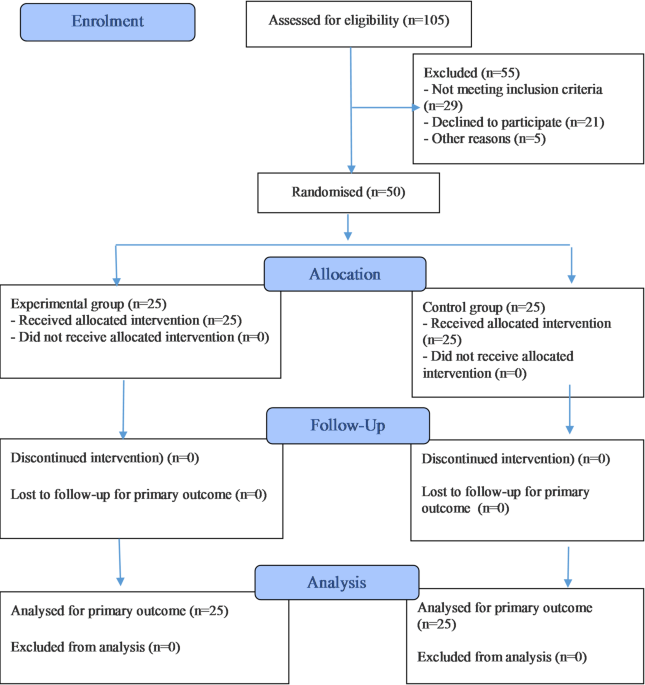
Psychophysiological and neurodynamic profiles of boxers
The HRV-BF group and the control group exhibited average performance in the attention and working memory tests, as shown in Table 1, whereas the values of the stress index indicated that athletes in both groups were becoming stressed. The t-test revealed that there were no statistically significant differences in attention, working memory and stress level between the two groups.
An average attentional skill was observed in 60% to 65% of the athletes regardless of the assigned condition. High levels of attention accounted for 30% to 32% of the participants, and low attention levels were observed in 5% to 8% of boxers. In terms of working memory, 40% of athletes in the HRV-BF group scored in the high range, 40% in the average range, and 20% in the middle range versus 44%, 35% and 15%, respectively, in the control group. About 68% to 70% of boxers in both groups were found to have an average level of stress. In the control group, however, there were several individuals (2%) with high levels of stress who experienced symptoms of stress.
The mean SSR reaction time was in the average range, as shown in Table 2. The functional level of the central nervous system (Loskutova method) was low, whereas the MSt and SE values were in the high range. The t-test confirmed the neurodynamic equivalence of the two groups at the beginning of the preparatory period.
Regardless of the assigned condition, most boxers (60% in the HRV-BF group and 64% in the control group) exhibited an average SSR reaction time. The remaining participants had either faster (18% and 20%) or slower (18% and 20%) reaction times. The MSt and SE values were mostly in the high range (50% to 60%), but nearly half of boxers (40% in the HRV-BF group and 48% in the control group) in the two groups exhibited average values of the MSt and SE. Some athletes, however, were found to have low strength endurance (2% to 3%).
Methodology for improving the functional state of boxers
Based on data from the initial measurements, the preparatory phase of the training program should include sensorimotor exercises. The maximal voluntary strength and strength endurance were tested for the right and left hands, but given the small value of skewness, it was decided to average the strength of both hands. Based on theoretical information, wrist strength depends on the level of arousal, which was revealed to be low in the sensorimotor reaction test.
To improve the functional state of teenage boxers in the preparatory period, a circuit-based physical activity regimen was developed. The training program consists of two phases: (1) increasing the absolute and explosive strength of the muscles as well as fatigue resistance, and (2) enhancing functional abilities. The exercise stations used in the first phase of the circuit training include simulators, weights, and exercises that involve training with your own weight (e.g., pull-ups on a horizontal bar). This phase lasts three weeks and consists of six training sessions. Athletes were instructed to complete a designated number of repetitions; there was no specific time limit on how long athletes could use the stations, but the total set fell within the time frame of a single round. The weights used in the workout stations were selected differentially. The recovery period between stations is one minute. The first circuit workout ends with a relaxation phase and a series of boxing-related tasks, the length of which is equal to that of a single round. After the first circuit, athletes were given a 2-minute break. The circuit workout routine includes three circuits in the first week of training, and four circuits starting from the second week of the training period.
Stations were modified by setting up time boundaries halfway through the first phase of training. Athletes were instructed to perform each exercise for 1.5 min, with 1-minute rest in between stations. Boxers were allowed to tailor the number of repetitions in each set in accordance with the instructions provided by their trainers. The HR threshold was 140–160 beats per min. If the HR was higher by more than 35–40 beats, the training load was reduced. After completing the first circuit, athletes received tasks for relaxation, followed by average-paced shadow boxing drills. Participants were given 2 to 3 min to recover between circuits.
The second phase of the circuit training with two sessions per week is to build functional strength. The exercise stations used in this phase are boxing equipment, light weights, skipping ropes, etc. The exercise duration is 1.5–2 min but is reduced to 1 min halfway into the second phase of training. The intensity level of training is high (170–180 beats per min). Athletes were instructed to focus on technical execution. Their pulse was measured immediately after completing the exercises and after the recovery period. If the recovery was incomplete (less than 40 − 35 beats per min), then some adjustments to the activity regimen were made. Once the duration of the rest period was reduced, more intensity was added to the workout. The recovery time remained unchanged.
Changes observed in the Psychophysiological and neurodynamic profiles of boxers after the intervention
Physical training resulted in improved attention, enhanced working memory, and lower stress in both groups, as shown in Table 3, with greater improvements in the HRV-BF group (31.9% for attention, 12.9% for working memory, and 47.2% for stress compared to 17.2%, 2.4%, and 11% in the control group). Overall, there were 20% more boxers with high attention and 25% more boxers with high working memory in the HRV-BF group compared to the control group.
There were statistically significant differences in favor of the HRV-BF group as determined by ANOVA, which implies that using biofeedback during the preparatory period of training is advantageous. The HRV-BF intervention had a pronounced impact on the psychophysiological state of athletes, specifically the attention and working memory variables. The analysis of the dynamic physiological indicators of stress revealed a positive trend. There were no athletes prone to experiencing the effects of stress found in either of the two groups. Despite this, the number of athletes with emerging signs of stress was 10% lower in the HRV-BF group compared to the control group. The results of the psychophysiological assessment suggest that physical training is positively associated with improvements in psychophysiological status, but these changes are more pronounced with a targeted functional training regimen. The neurodynamic assessment revealed that there was a statistically significant difference between the two groups with respect to SSR reaction time (Table 4). Other neurodynamic indicators were found to be higher in the HRV-BF group, but the differences were insignificant.
Based on ANOVA, the HRV-BF group demonstrated greater improvements in the FLS, MSt, and SE than the control group. While the HRV-BF intervention’s effect on the functional level of the central nervous system was large, the SSR reaction time exhibited a moderate improvement. The HRV-BF intervention had the smallest effect on the values of the MSt and SE, potentially indicating the need for more training sessions or a higher training load.
By the end of the preparatory period, all neurodynamic indicators have improved. The increments in the HRV-BF group were 7.9% for SSR reaction time, 12.8% for FLS, 11.9% for MSt, and 15.9% for SE. Improvements in the control group were 4.1% for SSR reaction time, 8.8% for FLS, 4.9% for MSt, and 11.9% for SE. Overall, there were 20% more athletes with fast SSR reaction time, 15% more athletes with high FLS, 5% more athletes with high MSt and 2% more athletes with high SE in the HRV-BF group compared to the control group.
At the initial stage of the preparatory period, there were no statistically significant differences between the two groups with respect to HR, SC and stress index (p > 0.05). After training, the HRV-BF group exhibited significant decreases in HR (70.1 ± 5.2 bpm) and SC (4.2 ± 1.0 c.u.) compared to the control group (76.5 ± 6.9 bpm and 5.7 ± 1.4 c.u., respectively), as shown in Tables 5 and 6 (p < 0.01).
The value of the stress index was significantly lower in the HRV-BF group (7.0 ± 5.0 points) than the control group (13.3 ± 9.3 points), indicating that biofeedback-based training is more effective than conventional boxing programs (p = 0.004). The effect sizes obtained for all physiological indicators range from medium to large.
link